A practical breakdown of what you’re actually paying for when you buy wood flooring
If you’ve spent any time shopping for flooring, you’ve probably noticed one thing: the price range is confusing.
You can find something for $30/sqm. You can find something for $300/sqm. Both claim to be “real wood.” Both look good in the showroom. So what’s the difference? And more importantly — how much should you actually be paying?
This guide cuts through the pricing fog and helps you understand what drives the cost of a wood floor, what’s worth paying for, and what’s just marketing.
First, Understand What You’re Actually Paying For
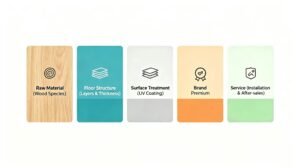
When you buy a wood floor, you’re not just buying wood. You’re buying a combination of things:
The raw material itself. Wood species matter. Oak costs more than pine. Walnut costs more than oak. Exotic species carry a premium. The quality of the log — how the wood was harvested, where it came from — also affects the price.
The construction. A solid wood floor uses more material and costs more to produce than an engineered floor. But even within engineered flooring, a 4mm top layer costs significantly more than a 1.2mm layer. More layers, better stability, and stronger adhesives all add to the cost.
The finish. Pre-finished floors come with factory-applied coatings that are more durable than anything done on-site. The number of UV coating layers, the type of finish (matte, satin, glossy), and the quality of the brushing or sanding all affect the final price.
The branding. You’re paying for marketing, showroom rent, and the salesperson’s commission. A big brand with a famous name often charges a significant premium for the same product made in the same factory as a less famous brand.
The service. Installation, warranty, after-sales support — these add real value, but they also add cost. And they’re often separated out in the fine print.
The Market Logic: Why Prices Vary So Much
Here’s a pattern you’ll see repeatedly: similar-looking floors can vary by 3x or 4x in price. Why?
Low-end floors (typically under $40/sqm for engineered wood) often use thin top layers (0.6-1.2mm), lower-grade wood, and thinner overall construction. They look like wood in photos, but in person, the texture feels flat, the grain looks printed, and the boards feel lightweight. These floors serve a purpose — rental properties, budget projects — but they are not the same product as a premium floor.
Mid-range floors (typically $60-120/sqm for engineered wood) use thicker top layers (2-4mm), better wood grades (AB grade rather than CD), and more stable construction. The surface feels like real wood because it is. The grain has natural variation. The boards have a solid weight to them.
High-end floors (typically $150+/sqm for engineered wood) use premium oak species, thick 4-6mm veneers, specialized finishes, and often come with advanced installation systems. These floors are designed for clients who care about longevity, refinishing potential, and the subtle beauty of real timber.
What “Too Cheap” Actually Means
If a price seems too good to be true, ask yourself: what’s being left out?
Very low-priced floors often mean:
Minimal wood in the product (thin veneer, cheap core)
Lower durability in high-traffic areas
Fewer refinishing options (you can’t sand a 0.6mm layer)
Less quality control (more boards with inconsistent coloring, poor machining)
No after-sales support (the seller doesn’t intend to stay around)
This doesn’t mean every low-priced floor is terrible. It does mean you should be clear-eyed about what you’re getting. If your budget is tight, a low-priced floor might be the right choice for a rental property or a short-term project. Just don’t expect it to last 20 years.
What “Too Expensive” Actually Means
Sometimes, a high price is justified. But not always.
A genuinely good floor costs more because:
It uses more material (thicker veneer, better core)
It has better stability (resists cupping and gapping)
It can be refinished (saving you money in the long run)
It comes with a warranty that actually means something
It’s backed by a company that will be there if something goes wrong
But sometimes, the price is high because:
The brand spends a lot on advertising and you’re paying for it
The showroom is in an expensive location
The salesperson is on commission
It’s being marketed as “premium” without the product actually being better
The trick is telling the difference.
The Price of Installation: The Hidden Cost
Here’s something people often forget: the floor itself is only half the cost.
Installation, underlayment, transition strips, removal of old flooring, subfloor preparation, and delivery can easily add 30-50% to your total project cost. A floor that looks cheap in the showroom becomes expensive once you factor in the labor to make it look right.
This is where quotes can mislead. A supplier might quote you a low price for the product, but then add significant fees for the things that matter — proper subfloor leveling, quality underlayment, experienced installers. Always ask for a full project quote, not just a product quote.
The Simple Rule for Price
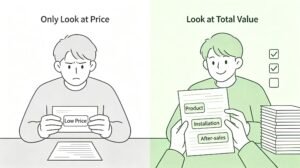
Here’s a rule that works for most projects:
“Pay for the thickness, not the marketing.”
The single most important indicator of quality in an engineered wood floor is the thickness of the top layer (wear layer). A 4mm layer is objectively better than a 2mm layer, regardless of the brand. A 2mm layer is better than a 0.6mm layer. The price should reflect this — and if a brand charges a premium for a thin layer, that price is based on branding, not value.
The second most important factor is stability — which usually means the number of layers in the core.
A 7-layer core is more stable than a 3-layer core for the same species and thickness.
Everything else is secondary.
What This Means for Your Project
When you’re evaluating flooring prices, here’s a framework to follow:
For a good value floor (solid reliability, good longevity): Look for a mid-range engineered wood with a 3-4mm top layer, AB grade, and a stable core. You should be in the $60-120/sqm range for the product alone.
For a budget floor (light use, short-term): Look for a lower-cost engineered wood with a 1.2-2mm top layer. Expect to pay $30-50/sqm. Know that you’re trading quality for price.
For a premium floor (heirloom quality, long lifespan): Look for a 4-6mm top layer, premium oak species, and a high-stability core. Expect to pay $150+/sqm for the product.
For the best value: Look for a mid-range engineered wood that offers a thick top layer without the expensive brand name. You can often find excellent quality for $50-80/sqm if you’re willing to look beyond the famous brands.
Ready to find the right floor for your budget? We offer engineered wood flooring across a wide price range — transparent pricing, no hidden fees, and factory-direct value.
📩 Contact us for catalog and samples.