A Practical Guide to Choosing the Right Installation Method for Your Engineered Wood Flooring Project
One of the most frequently asked questions when installing engineered wood flooring is: Should I choose a fully glued installation or a floating installation?
Both methods have their supporters, advantages, and disadvantages. The right choice depends on your project type, budget, subfloor condition, and long-term expectations.
This guide details everything you need to know about these two installation methods—so you can make an informed decision with confidence.
What is a Floating Installation?
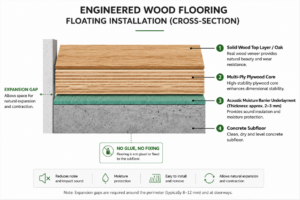
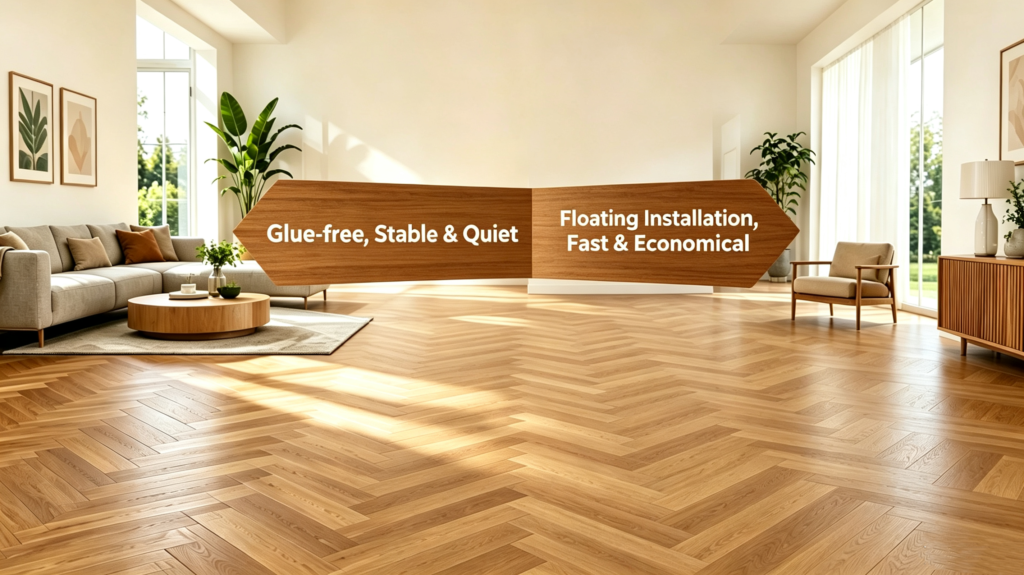
A floating installation means the flooring is not connected to the subfloor. Instead, the flooring strips are interlocked—usually via a snap-fit or tongue-and-groove system—and then laid on the underlayment.
The flooring “floats” above the subfloor, with small expansion joints around the edges to allow for natural movement of the wood.
Advantages of a Floating Installation
Quick and Easy. Floating flooring is quick to install. No glue is needed, and there’s no waiting for it to dry—you can walk on it immediately after installation. For DIY enthusiasts, floating flooring is the most convenient option.
Affordable. Floating installation is more economical because there’s no need to buy adhesives and labor costs are lower. It is often the preferred option for renovations of rental properties, investment properties, or first-time homebuyers.
Easy to remove and replace. Floating floors can be removed and may be reused. Damaged sections are easier to inspect and replace compared to adhesive floors.
Can be laid directly on existing subfloors. As long as the surface is flat and stable, floating floors can usually be laid directly on existing tile, vinyl, or concrete, saving time and removal costs.
Disadvantages of floating installation
Hollow sound and wobbling underfoot. The most common complaint is a hollow “thump” sound when walking on the floor. This is caused by a gap between the floor and the subfloor. Some people also notice a slight wobble underfoot.
Poor stability in harsh environments. Floating floors are more sensitive to changes in temperature and humidity. In areas with large humidity fluctuations, they may expand, contract, or develop gaps.
Limited compatibility with underfloor heating systems. Floating floors can create an insulating air layer, reducing heating efficiency and potentially voiding the warranty for some systems. Typically, the floor needs to be in direct contact with the subfloor for optimal heat transfer.
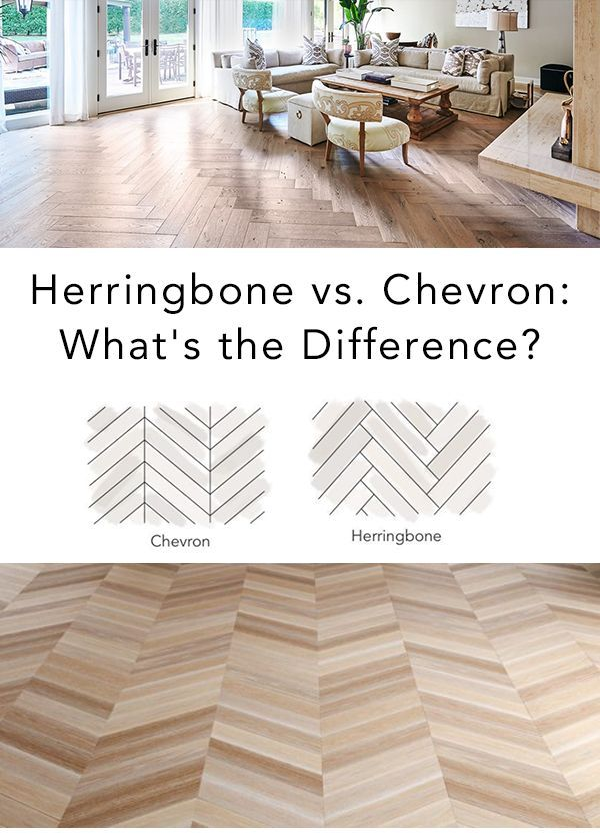
Pattern Restrictions. Floating installations are generally limited to straight-line laying. Complex patterns such as herringbone or V-shapes are difficult to achieve with floating installations and are therefore not recommended.
What is Fully Glue-Down Installation?
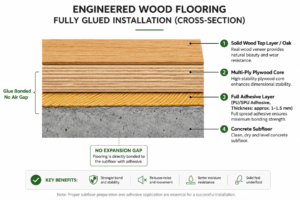
Fully glue-down installation refers to each plank being directly and permanently bonded to the subfloor using a special adhesive. The planks are firmly fixed with no gaps underneath.
Unlike floating flooring, adhesive flooring requires a flat, clean, and dry subfloor. After applying the adhesive, the planks are pressed into place and then allowed to cure.
Advantages of Fully Glue-Down Installation
Superior Stability. Adhesive flooring is permanently fixed to the subfloor and will not shift, warp, or develop gaps, even under high traffic or rolling loads. Therefore, they are ideal for commercial spaces, offices, and retail environments.
No Hollow Sounds. Because the planks are bonded directly to the subfloor without air gaps, there is no hollow “thumping” sound. The flooring feels solid and quiet underfoot.
Better Compatible with Underfloor Heating Systems. Wood in direct contact with heated flooring allows for highly efficient heat transfer. In contrast, floating flooring may reduce heating efficiency.
Suitable for complex patterns. Herringbone, V-shaped, and parquet patterns—which involve many small cuts and angles—are best installed using adhesive bonding to maintain the integrity of the pattern.
Easier to refinish. Adhesive-bonded flooring is easier to sand and does not spring back during sanding like floating flooring.
Better acoustic performance. Glue-down installation typically achieves better sound insulation than floating alternatives, making it the preferred choice for apartments and multi-storey buildings with strict acoustic requirements.
Disadvantages of Full Glue-Down Installation
Higher cost. Glue-down installation requires adhesive, professional application, and more labour time. Expect to pay 30–50% more in labour compared to floating.
Difficult to replace. Once a glued-down plank is damaged, replacing it is more complex and expensive than replacing a floating floor plank.
Subfloor preparation is critical. The subfloor must be dry, level, and completely clean. Any imperfection will telegraph through the finished surface.
Not a DIY job. Glue-down installation requires experience with adhesive application, timing, and proper trowel technique. Mistakes are difficult and expensive to correct.
Comparison Summary
Installation Speed
Floating Installation: Fast (1-2 hours for a room)
Full Glue-Down Installation: Slower (requires adhesive application + 24-48hr cure time)
Labour Cost
Floating Installation: Lower
Full Glue-Down Installation: Higher (30–50% more)
Material Cost
Floating Installation: Lower (no adhesive)
Full Glue-Down Installation: Higher (adhesive required)
Subfloor Preparation
Floating Installation: Minimal
Full Glue-Down Installation: Extensive (must be flat, dry, clean)
DIY-Friendliness
Floating Installation: Yes
Full Glue-Down Installation: No
Stability
Floating Installation: Moderate
Full Glue-Down Installation: Excellent
Underfoot Feel
Floating Installation: Hollow/drumming sound
Full Glue-Down Installation: Solid and quiet
Underfloor Heating Compatibility
Floating Installation: Limited compatibility
Full Glue-Down Installation: Recommended
Pattern Options
Floating Installation: Straight plank only
Full Glue-Down Installation: All patterns (herringbone, chevron, parquet)
Repairability
Floating Installation: Easy to replace sections
Full Glue-Down Installation: Difficult to replace
Acoustic Performance
Floating Installation: Lower (requires acoustic underlay)
Full Glue-Down Installation: Better (meets stricter strata requirements)
Commercial Use
Floating Installation: Not recommended
Full Glue-Down Installation: Recommended
Quick Guide: Which One Should You Choose?
Choose Floating Installation if:
You’re on a tight budget
You’re a confident DIYer
You want a fast installation
You’re installing in a rental or temporary space
You might want to remove the floor in the future
You’re laying straight planks in a standard residential room
Choose Full Glue-Down Installation if:
You want maximum stability
You’re installing herringbone, chevron, or parquet patterns
You need excellent acoustic performance (apartments, commercial spaces)
You have underfloor heating
You want the quietest, most solid underfoot feel
You’re installing in high-traffic commercial areas
You’re willing to invest in a permanent, long-lasting floor