A complete guide to understanding the stability of different wood flooring types
When it comes to wood flooring, “stability” is one of the most important factors to consider. A stable floor resists warping, cupping, and gapping when temperature and humidity change. An unstable floor will expand, contract, and deform — leading to gaps, squeaks, and costly repairs.
But not all wood floors are created equal. Different materials, constructions, and species perform very differently when it comes to dimensional stability.
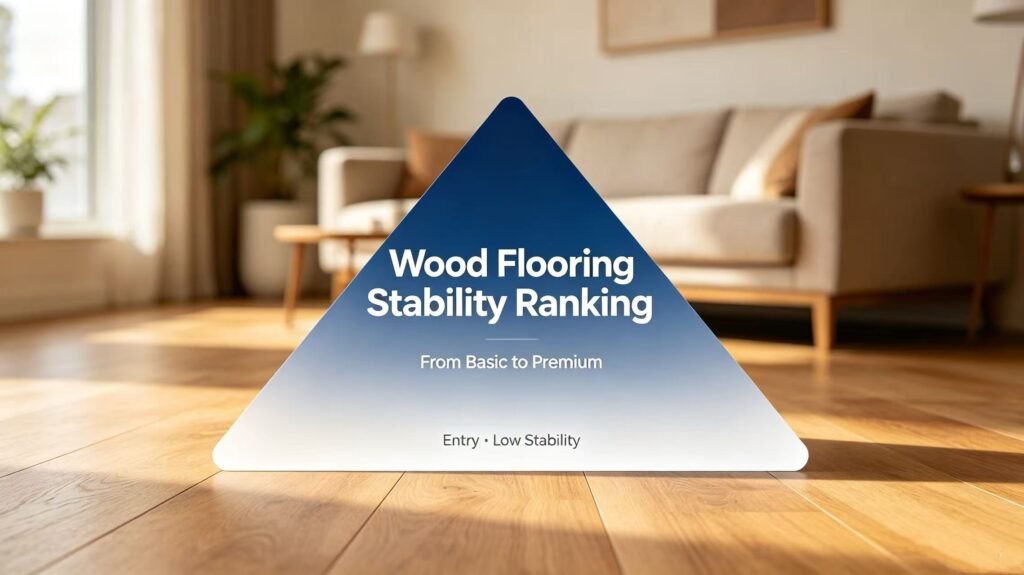
This guide ranks wood flooring types from least stable to most stable, so you know exactly what you’re getting at each level .
The Bottom Tier: Least Stable Options
Solid Hardwood (Thin Boards, Soft Species)
Solid hardwood is made from a single piece of wood, which means it expands and contracts significantly with humidity changes . Species like birch, ash, and maple have higher shrinkage rates (over 2.2%), making them more prone to warping and cupping .
Stability rating: Low
Why it’s unstable: Single-piece construction offers no cross-layering to resist movement. Soft or fast-growing species are particularly vulnerable .
Best for: Dry, climate-controlled interiors with minimal humidity fluctuation
Traditional Multi-Layer Engineered Wood (Structure A & B)
Multi-layer engineered wood is more stable than solid hardwood, but not all constructions are equal. Older or budget engineered constructions (known as Structure A and B in research) have been shown to be more prone to warping and surface checking in heating environments .
Stability rating: Low to Medium
Why it varies: Structure A (thick 4mm veneer + poplar core) and Structure B (1.2mm veneer + plywood layer + poplar core) performed worse in heating tests compared to higher-grade engineered constructions .
The Mid Tier: Better Stability
High-Quality Multi-Layer Engineered Wood (Structure C)
Multi-layer engineered wood with a plywood core (7+ layers) offers significantly better stability than both solid hardwood and basic engineered constructions .
Research confirms that this construction (Structure C) resists warping better than other engineered constructions, especially when combined with mono-block veneer .
Stability rating: Medium to High
Why it’s better: The cross-layered plywood core minimizes expansion and contraction, and is less prone to warping .
Best for: Residential and commercial applications where stability is a priority
Engineered Wood with Premium Wood Species
The species of the top veneer also affects stability. Research shows that birch provides the best dimensional stability among common species, followed by eastern black walnut, eucalyptus, and maple .
Stability rating: High
Why species matter: Different woods absorb moisture at different rates. Lower shrinkage rates means better stability .
Best for: Projects where consistency and resistance to movement are key
The Top Tier: Most Stable Options
Engineered Wood with Mono-Block Veneer
The shape of the decorative veneer impacts stability. Mono-block veneer (single piece) performs better than three-splice veneer (three pieces joined together) in heating environments .
Stability rating: Very High
Why it’s better: Mono-block veneer provides more uniform movement across the board surface, reducing stress points .
Premium Engineered Wood with Birch Veneer
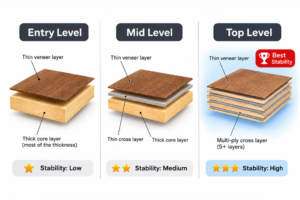
According to research on flooring for heating systems, engineered wood with birch veneer and multi-layer plywood core (Structure C) was the best combination for dimensional stability .
Stability rating: Highest
Why it’s the best: The combination of stable core construction, mono-block veneer, and birch’s naturally low shrinkage rate creates the most dimensionally stable engineered wood flooring available .
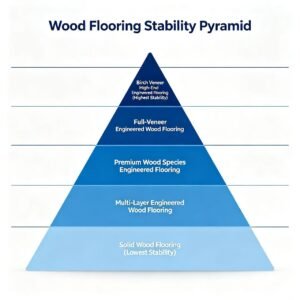
The Full Ranking
From least stable to most stable:
Solid hardwood (soft species, birch, ash) – Shrinkage >2.2%, prone to warping
Basic engineered wood (Structure A & B) – Higher warping and checking risk
Multi-layer engineered wood (Structure C) – Improved stability from plywood core
Engineered wood with premium species (walnut, eucalyptus) – Lower shrinkage rates
Engineered wood with mono-block veneer – More uniform movement
Premium engineered wood with birch veneer + Structure C – Optimum stability for demanding environments
What This Means for Your Project
Stability is critical for wood flooring, especially in environments with underfloor heating, high humidity, or seasonal temperature changes .
If you’re choosing solid hardwood, expect natural movement — leave expansion gaps and control indoor humidity
If you’re choosing standard engineered wood, look for a multi-layer plywood core (Structure C) for better stability
If you’re choosing premium engineered wood, opt for birch or walnut veneer with mono-block construction for the best dimensional stability
The most important factor: The construction and species of your engineered wood flooring determine its long-term stability. Investing in higher-grade engineered wood with a multi-layer core and stable veneer will reduce the risk of gaps, warping, and costly repairs down the line.
Ready to find the right stable engineered wood flooring for your project? We offer premium engineered wood with multi-layer cores and birch, oak, and walnut veneer options — factory-direct at competitive prices.
📩 Contact us for catalog and samples.