A complete guide to understanding how wood flooring affects underfloor heating performance
Underfloor heating is becoming a standard feature in modern homes. But many homeowners find that even with the same heating system, some rooms feel warmer than others — and the culprit is often the floor itself.
Not all wood floors perform the same way underfloor heating. Some conduct heat efficiently, warming your room quickly. Others act like a thermal blanket, slowing down heat transfer and making your system work harder.
This guide breaks down the science of thermal conductivity in wood flooring, so you know exactly what to look for when choosing floors for your underfloor heating project.
The Science Behind Thermal Conductivity
Thermal conductivity is the ability of a material to transfer heat. In simple terms: the higher the thermal conductivity, the faster heat passes through the floor and into your room.
Wood is a natural insulator. The thermal conductivity of wood-based flooring materials typically ranges from 0.091 to 0.125 W/mK, which is very low compared to materials like tile or stone. For context, the thermal conductivity of ceramic tile is about 1.5 W/mK — roughly 15 times higher than wood.
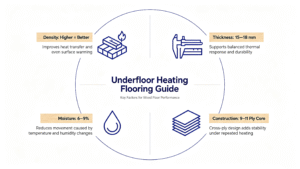
But within wood flooring, there are significant differences. Research has identified four key factors that determine how well a floor performs under heating: density, thickness, moisture content, and construction type.
1. Density — The Heavier, The Better
Density is the biggest factor affecting thermal conductivity. The study found that higher-density flooring transfers heat more efficiently.
Here’s why: denser materials have less air trapped inside them. Air is an excellent insulator, so the more air in your floor, the slower heat passes through.
Among common flooring types, laminate flooring with its high-density fiberboard core showed the highest thermal conductivity in tests. Multi-layer engineered wood with plywood cores demonstrated lower thermal conductivity — not because of poor construction, but because plywood has lower density compared to HDF.
Solid wood falls somewhere in the middle, with thermal conductivity varying by species.
2. Thickness — Thinner is Faster
Thinner floors transfer heat more quickly. This seems obvious, but the research quantified just how much difference thickness makes.
The equivalent thermal conductivity of a floor is calculated as thickness divided by thermal resistance. In plain English: for the same material, a thinner floor has less material for heat to travel through, so it warms up faster.
For underfloor heating, the ideal total thickness is generally considered to be 15–18mm. Floors thicker than 20mm will noticeably slow down heat transfer.
3. Moisture Content — Dryer is Better
Wood is hygroscopic — it absorbs and releases moisture from the air. And moisture content directly affects thermal conductivity.
Higher moisture content means water replaces air pockets in the wood, which actually increases thermal conductivity. However, this comes with a trade-off: higher moisture content also increases the risk of dimensional changes (expansion, contraction, warping) when exposed to heat.
For underfloor heating, the ideal moisture content is 6–9% — dry enough for stability, but not so dry that it compromises heat transfer.
4. Construction Type — Not All Engineered Floors Are Equal
Different flooring structures show different thermal performance:
Laminate showed the highest thermal conductivity due to its high-density core and thin construction layers. However, its heat stability is only medium — the HDF core can be sensitive to moisture and temperature cycles.
Multi-layer engineered wood with a plywood core (9–11 layers) offers the best balance for underfloor heating. While its thermal conductivity is slightly lower than laminate, its dimensional stability is far superior — meaning less risk of gaps, warping, or delamination over years of heating cycles.
Three-layer engineered wood falls in between, offering good stability with medium-high thermal conductivity.
Heat Storage and Release — The Hidden Factor
Beyond thermal conductivity, there’s another factor: thermal storage capacity (also known as thermal inertia).
This is where solid wood and engineered wood differ significantly. Solid wood has higher density and mass, giving it better heat storage capacity. Once heated, solid wood releases heat slowly over time — which sounds good, but in practice it means slower response times.
Engineered wood, with its multi-layer construction, has lower thermal mass and responds faster to temperature changes. This is actually an advantage for underfloor heating: you get quicker warm-up times and more responsive temperature control.
What This Means for Your Project
When choosing flooring for underfloor heating, keep these key factors in mind:
Density matters most. Higher density flooring transfers heat more efficiently. Among common options, laminate offers the highest conductivity, while multi-layer engineered wood provides a strong balance of performance and stability.
Thickness is crucial. Floors that are 15–18mm thick are ideal for underfloor heating. Anything over 20mm will slow down heat transfer noticeably.
Moisture content affects performance. Keep it between 6–9% for the best combination of stability and heat transfer.
Construction type determines long-term reliability. Multi-layer plywood core (9–11 layers) offers the best dimensional stability under heating cycles — meaning fewer gaps, less warping, and longer life.
The research shows that choosing a floor that’s too thick, too low-density, or too high in moisture content can reduce your underfloor heating efficiency by a significant margin — which means higher energy bills and slower heating response.
The Bottom Line
For underfloor heating, multi-layer engineered wood with a plywood core offers the best balance of thermal conductivity and dimensional stability. It won’t transfer heat as quickly as tile, but it gives you the warmth and beauty of wood with much better thermal performance than solid hardwood.
When shopping for flooring, ask for:
Construction type: Multi-layer plywood core (9–11 layers)
Total thickness: 15–18mm
Top veneer thickness: 3–4mm (can be refinished 2–3 times)
And remember: thinner isn’t always better if it compromises stability. The sweet spot is a 15mm engineered floor with a 3mm top veneer and a stable plywood core — warm, durable, and built to last.
📩 Have questions about choosing the right floor for your underfloor heating system? Contact us for expert advice and samples!